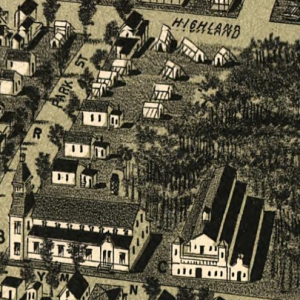
Note: Taken from a Boston Globe article dated November 3, 1890 and transcribed directly as is. As noted, Indian Jim was located in a tent in the grove next to the Temple Theater. The grove is smaller, but is still there next to the parking lot that is where the Temple Theater was located.
*********** Beginning of Transcription ***********
Chats with a Big Chief at Onset Bay.
He and His Wife Live in a Tent and Make Baskets for Sale.
They Come from the Wild West and Lived Many Years on the Plains.
By all the desultory transient residents of Onset Bay, as well by the woodchoppers out in Charlemont and Zoar, he is called “Indian Territory Jim.” and from this the name was contracted to “Indian T Jim,” until now he simply stands out plain “Indian Jim.” He was born and bred out on the boarders of Oklahoma, and there it was that he obtained his superb frame and giant physical strength.
For 25 years he lived on the plains and never saw a steam engine, white woman or a church. Then, game growing scarce, he came east with his smoke-colored wife and began to haunt the summer resorts, giving exhibitions of his great strength, and selling baskets and bows and arrows. Until last summer, he generally made Narragansett Pier or Long Branch his resort, but early last July he packed up and came to Onset Bay, where he made friends and money by his arts.
One Sunday early in August I found him in his tent a short distance from the “Temple” in the grove. His wife and their little son, about 5 years old, were with him. They are all typical Indians, but, though wearing the garb of civilization, their every act and gesture declare them to be the offspring of the woods and fields.
Jim said he was doing a fair business in baskets and weapons, but his feats of strength were not appreciated to the financial extent he could wish. For a quarter he consented to show me what he could do. Undoing his long black hair, and braiding it up into two plaits, he got down upon his knees and asked me to take a plait of hair in each hand, He also told me to hold up my feet as he was “goin’ to lif’ up.” I did as l bade, and he took me from the ground as easily as I could lift a pail of water. At that time I weighed 235 pounds, so this feat was not an easy one to perform.
After this he tied some spun yarn around a cask filled with water, put the tarred rope far in between his big white teeth, closed his jaws, and up came the cask, water and all. Its weight could not have been far from 250 pounds. He performed several other similar feats and at the end of half an hour was perspiring freely. All this was done for 25 cents.
“How much have you earned this summer by lifting?” I asked.
“Um, I don’ know. One, two, six, ‘leben about fifteen dollar, I guess. It don’ pay cos dese folks no want see me. Dey duther buy candy and hug squaw.” The shrug of contempt he gave then would have made a fortune for an actor.
“Do you sell many baskets?” was my next question.
“Yes. Sell heap baskets. Good money. good living. But baskets take much work to make. Work, work all time. Squaw get tired and sick, she work so hard.”
“Do you make any baskets?”
“No. I pound wood. My squaw, she do all braiding. No use work so hard.”
“How much do you get for baskets?”
“Sell you this one for two dollar. Buy him?” It was a pretty basket, and so the purchase was made.
All this time the boy had been fixing a split stick in the ground about two rods me to give him a cent. He got a nickel. It was put inside the cleft in the stick, the boy came back, an arrow was drawn across the bow, and “whang,” the 5-cent piece was out of the stick and on the ground.
‘Now you try him,” said the boy, giving the bow and arrow to me. I took aim and “let go,” but the arrow overshot fully two feet.
“My money now,” said the boy, putting the coin in his mouth.” Try again.” Several times we essayed our skill, and it is needless to say the boy won every time.
“Do you make canoes?” I inquired.
“Yes, we make canoe. You buy one? Sell him for $30, $40, $50 or $100. He all birch; very good. Las’ long time.”
I declined to purchase, and by way of shifting the talk from trade, asked him what he did to get a living winters.
“Cut cord wood at 75 cents a cord out near big tunnel-what you call him?-
Hoosac?”
“Can you put up two cords a day?”
“Um. Yes. I put up three cords and a half or four cords in good choppin’. Some day I only put up one cord or half cord in very bad choppin’. Hard work.” and he put his hand lovingly on his back to indicate the place where it made him ache.
“Where does your squaw stay when you chop cord wood? Does she go out to the territory again?”
“No: she live right in camp with me; cook grub, make basket, loaf.”
“What did you do for a living when you where on the reservation?”
“Hunt an’ fish mos’ time. Then I be guide an’ scout for soldiers and men who measure lan’. That was good work. I like it well.”
“What made you quit this employment?”
“Shoot white man. He kill my dog. I shoot him. Big row. Hang me if they catch me. I run away. It all right now. but I no get any more work. So I come here an’ sell baskets.”
“Did you ever have any exciting times out at Oklahoma keeping out the white settlers?” was asked.
“Who, ‘boomers?’”
“Yes.”
“Have much fine time. Me ‘rest lots white men, and chase many more; no catch’em. They run away.”
“Tell me about the best time you ever had?”
“I have so many that I can’ tell the bes’. One the bes’ was when I find pair of horses and big cart with nobody to look out for thim. He was a very good time.”
“Please tell me about it.”
“It was in ’79 or ’80 that I was out with 10 soldiers to look for the squatters. I was guide. I tell sergeant night before I see smoke. White man mus’ be there. He say, ‘Go with me morning, we get ’em.’ So we go. We find cart by bank of little stream, and two horses feeding close by. Cart all good. Full of flour and bacon and whiskey. No man’s there. Sergeant see sign on cart. He say it read, This Indian’s cart.’ I say it was a lie. But no man’s in sight.
“Sergeant and his men eat lunch. I go out to look for cart men. No one near. Use all the big glasses, but mans all gone. Then I come back by stream and sit down and think. White mans mus’ be here, I know. I look in water. Red and muddy. I look again. See three milkweed tops in water all close together. Milkweed land plant. It don’t grow in water.
“I go an’ fin’ sergeant and men. ‘Come.’ I says, ‘we have lot fun.’ He laugh and say, ‘Where?’ I say, ‘Come.’ He and men come. I go to stream. I reach over and pull out all the milkweeds. They come hard. Very strong root.
“Sergeant say, ‘What for?’ I say, ‘Wait.’ Bymby up come one white mans all wet. He laugh and say he caught. Then up come two more. We have em all. Heap fun.”
“But for what did they use the milkweed?” I asked.
“Stalk of milkweed hollow. They cut off top. Hole all through it. Run right down to mouth of mans under water. He breath all time first-rate. Water muddy. No see him. All I see is milkweed. Pull him out. Mans mus’ come up to get bref. Much good time.”
“What did you do with the men?”
“Oh, sergeant, he laugh. Men, they all laugh. So did soldiers. We all eat big dinner. Drink whiskey and smoke. Big time. Sergeant take all whiskey and tell men to go home. They go. No see the many more. We all get drunk on whiskey and have big headache. It was very much good time. Like to do it again.”
“Did you ever shoot any buffalo?” was the next question.
“No, not much. He very scarce. No plenty at all. Catch one calf when I was a boy. Tame him and yoke him up. He haul me all aroun’ just like horse. One day he ran away and throw me off. No see him any more for two week. Then I find him away out on plain. I call him. but he no come to me, so I shoot him. Here is his hide in tent. He eat very good.
” In this way Jim went on to tell of the adventures on the frontier. He said he had learned to chew and smoke before he was 10 years of age, and had been drunk before he was 15. As to playing cards and other games, he did not know anything about them. He had several well-located masculine vices, but gambling was not one of them. His religion, if he had any, did not appear to cause him any great uneasiness, and one creed was as good as another to him, so long as he could get a living.
Just before he came East he had married the wife who now lives with him. She was the nut-brown belle of the tribe, and though many braver and better-looking men had asked for her hand Jim won the prize without trouble. In making this capture he employed no strategy. and laid no deep plans to overthrow his rivals.
The maiden was of a marriageable age. Her father thought she should be wedded So Jim went to the old man and made a bargain. He gave his father-in-law about-to- be four blankets, ten pounds of tobacco and five gallons of whiskey. None of the other suitors had so much property in hand, and were compelled to submit to fate and financiering.
The next day the wedding came off. All the braves got drunk, and for about a week a big time was had. Then Jim took his bride and went East. Hé has not been back since.
“I no go there any more.” he said.
“Why?”
“Oh, she love a big Indian. He love her, too. He have lots of cattie now. He be very rich. If squaw go back he steal her from me. She work good. Make basket. Cook grub. Cut wood. She much good to me. I want her. He no get her. So I stay here,
GILL FORD.
******** End of Transcription *******************