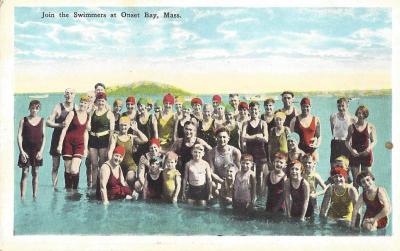
George Kashimura on Onset Beach with his “swimmers”.
Local Onset historian and lecturer, Marie Strawn, has done extensive research on Mr. Kashimura. Some of her work is presented here:
Who was George Kashimura?
My first purchase of a card published by George Kashimura, actually an Onset folder, was at this club’s show in 2001. The very first show I attended, and I learned an old family friend had actually been a publisher of post cards. I had known the Kashimura family all my life. George had taught me how to swim, and my grandmother had purchased tea sets, dolls, and cloisonné items at his gift shop. I just never realized he published and sold post cards of his beloved home town.
After the purchase of the folder, I began hunting for cards he published. I also tried to find out more about George’s life story. I knew he was born in Japan, but I had no idea how he happened to arrive in our little town. I knew George gave free swimming lesson to the children at Onset Beach, and my mother had told me about how he got the community to pitch in and clean up the beach of eel grass and old spikes in the water.
A trip to the library was the start. I found George’s name first appearing in the street list in Onset in 1916. The Research Librarian found his name in the 1910 census in a boarding house in Minneapolis. The 1920 and 1930 census found him in Onset. She found his draft registration card from 1917-18, listing him as an Onset resident. But my absolute biggest stroke of luck was Googling his married daughter, who lives in South Carolina. Her emails have been priceless. She has related anecdotes, furnished details of his immigration and college matriculation, details of his shops in Florida and Onset, and reproduced newspaper articles about George for me. She noted that George had selected his Anglicized first name from George Washington, whom he greatly admired
He was born Katsusaburo Kashimura on October 8, 1884,in Mito, Japan. After attending Waseda University in Tokyo, he left Japan at age 23. He arrived in Oregon in 1907 to study at Northwestern University, but never enrolled. He did some extensive travel by train, and we know he was in Minneapolis in 1910. Now the mystery is: why?? It appears he was with a fellow Japanese man, listed as John Endo in the census. But George’s daughter told me that he was acquainted with members of the Ando family, a premier maker of high quality cloisonné art goods. This firm is still in business today, with offices in Tokyo and Nagoya. According to his daughter, George bought out all the remaining goods from the Ando family after a large exposition on the West Coast in 1910.
Soon after that, George arrived in Florida and opened shops in St. Petersburg, Orlando, and Daytona Beach. The wealthy Northerners were just learning of the wonders of the” Sunshine State” in the winter. It was also a time when there was a keen interest in Oriental art goods.
One of the clerks in his store was a young lady from New Hampshire named Bessie Chase. Fleeing a teaching job in a one room school in New Hampshire, she had answered an ad for a saleslady in a Japanese Art Goods shop. George and Bessie were married on May 10, 1915.
Seeking a profitable outlet for the summer season, they traveled to the Northeast, looking for a place to open a shop. How they came to Onset is kind of a mystery, but they did buy out the Japanese Bazaar from another Japanese family, the Chicksukas, in 1916. At first, George and his wife spent winters in Florida and summers in Onset. However, as their children arrived in 1918 and 1919, they realized the logistics of travel were becoming very involved. As the children approached school age, they were attracted to the better schools of the North. By the early ’20’s,they were in Onset year round.
George must have been impressed by the potential of the beach and the bustling village of seaside vacationers. In those days, Onset attracted visitors from New York and Boston by train, and from New Bedford and Brockton by” electric car” or trolley. There were many seasonal shops: linen stores with fine Madeira cutwork, gift shops with all sorts of souvenir china from Germany, and Post Cards!
George saw Onset Beach as a valuable asset. When he arrived in Onset, the beach had large expanses of eel grass and sunken posts in the water that had been used to moor dinghies of those who had built structures on the beach. Those structures had been removed after the Supreme Court decision of 1916, but the mooring posts had been left. Enlisting the Boy Scouts and local swimming enthusiasts, aided by the Onset Women’s Club, the beach was cleared of all debris. It was developed into a first class swimming beach with the addition of a Red Cross first aid station, and Red Cross trained lifeguards, complete with lifeguard tower. Some of his cards feature these structures. Many cards show the beach, the harbor, and the bluffs overlooking them. George instituted free swimming lessons for the children at Onset Beach, and I was one of his students in 1941.Thousands of children took advantage of this kindly man over the decades of his dedication to the beach.
Just as the Kashimuras opened their Japanese Bazaar in Onset, there was a momentous Massachusetts Supreme Court decision, which caused the Onset Bay Grove Association, the developers of all the lots in Onset, to rescind the deeds of the owners of property on the public beach and parks. When the original lots were sold, the purchasers had been guaranteed the free use of all beaches and parks” for the public enjoyment in perpetuity.” Those original owners sued the Association, with the result that all homes and businesses had to be removed from the beaches and parks. Holmes’ Casino, located across from the pier, had been erected on park land. The casino had to vacate the property, and Holmes of Brockton did not relocate in Onset. They had been a major publisher of Onset cards.
Dickerman of Taunton, another prolific publisher of Onset cards, seems to have slowed production in the 20’s.
Many of the Kashimura’s shop’s goods were high-end merchandise: china tea sets, silk kimonos, cloisonné from Ando, and ivory carvings. He may have realized that post cards would attract a wider variety of customers. The earliest postmarks I have on his cards is 1920. Most cards are white border, pre-linen, full color cards. I have located a few linen cards of his, but they are hard to find. The later white border cards are postmarked in the late 30’s, but may have been stock left over from years before.
George had to close his shop for good when WW2 began. He never reopened it after the war. The building was severely damaged in a gas explosion in July of 1946, and George had to move to a house nears ours on Highland Ave.
I have round cards of five different series. The earliest ones, dating in the early 20’s, have no printer’s attribution, but the font style on the words Post Card is almost identical to Tichnor’ s cards of the same era. Also, Post is on one line, and Card is below it to the right. Both words are to the right of the center line, near the stamp box. This is also similar to Tichnor’ s cards. The lettering is quite large, and the P, t, and C are very stylized and florid. The stamp box has letters in each comer: E, C, K, and Co. I have cards from series ranging from 21225 to 24402.
The next type of card has dark blue lettering. The words post card are in the same part of the address side, but the letters are all capitals, and there are no serifs. The stamp box has the same four letters, and the numbers of the cards I have range from 21226 to 30823N. The dates of the postmarks range from 1924 to 1931.
I have similar blue lettered cards from the late 20’s. Their numbers range from 30823 to 3083lN. These cards are printed in very exaggerated pre-linen colors.
Also in the late 20’s, there are other blue-lettered cards very similar to the former, but the stamp box has changed to one with a segmented frame, with the same letters in the comers. What is new, is that George’s name has moved from the left side of the card to the middle of the center line.
I have only two cards, very similar to the latter, where the lettering is in purple. The font is the same, the stamp box is the same, and George’s name is in the center line.
Now the majority of the cards I have, and the easiest to find, are from the 30’s. The lettering is lighter blue, with flourishes on the P and C. Somevery light, feathery type scrolls surround the words” Post Card.” This style of lettering is identical to Tichnor’s cards of the same era. And, for the first time, Tichnor is listed as printer, and George’s name is back on the left side of the card. The stamp box is now very plain; there are no letters in the comers.
I have located a few linen cards of his. They are also printed by Tichnor. None has a post mark, and they are borderless. I would guess them to be from the early 30’s.
The best part of collecting Kashimura cards is that they are easily found, and prices are very reasonable. The most expensive card I have cost $7.00. He was very fanciful about the wording on his cards. It can range from ” A Wonderful Time Bathing and Speed Boat Racing” and “View from under the Shade Trees, Onset Bay, Mass.” He even composed six-line verses about” A Good Old Time at Onset Bay.”
George was a wonderful individual, eager to improve his hometown, and helpful to all its citizens during his years in Onset. He eventually moved to Hawaii in 1961, living for 11 more years on his own, swimming daily. In fact he died of a stroke on his way to the beach on February 5, 1972 at the age of 88.